Lean canvas definition

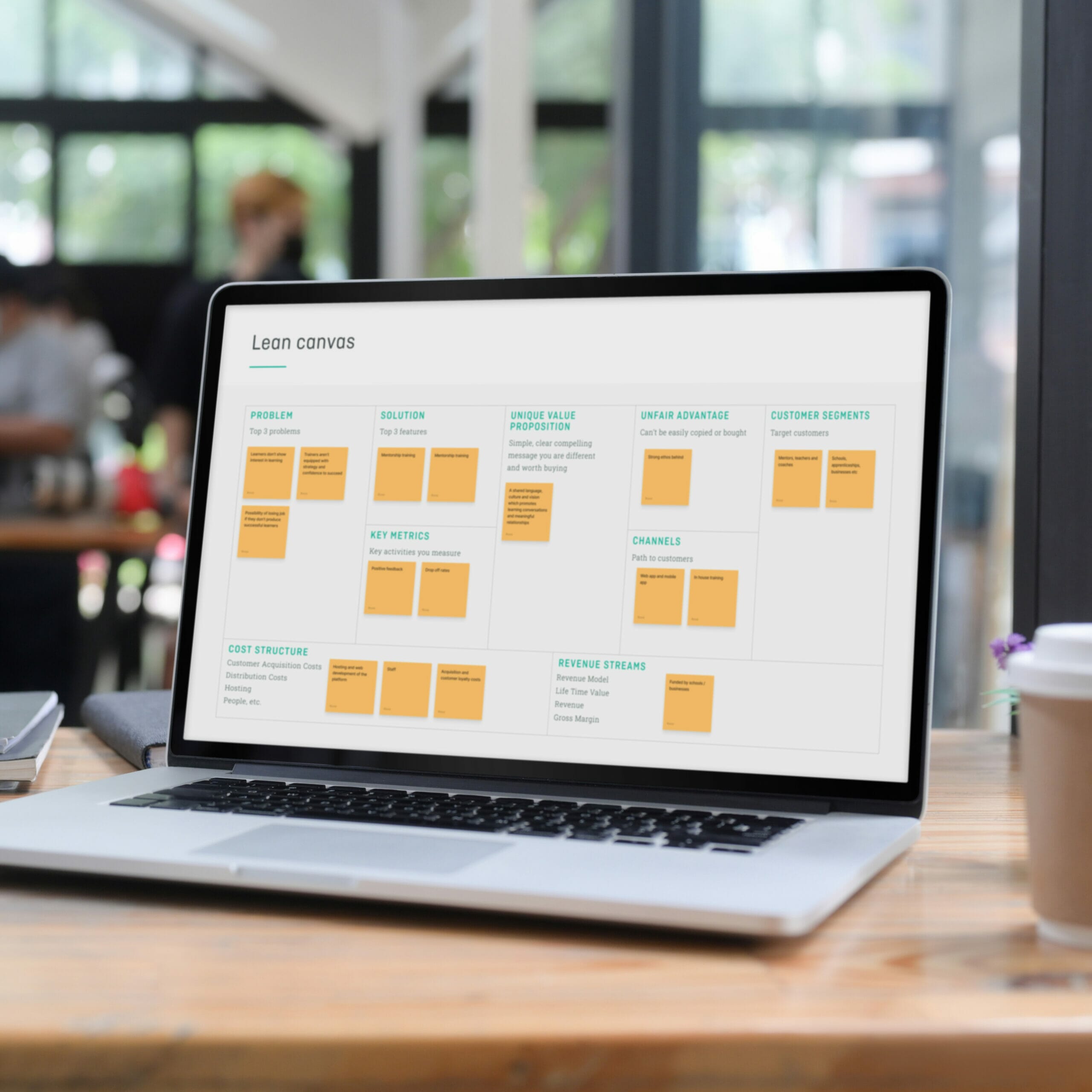
Lean Canvas is a business planning tool used to quickly outline key aspects of a product concept. We run Lean Canvas sessions with your team to clarify ideas, surface assumptions, and align strategy before design and build begin.

Lean canvas

Simplifying traditional business models

Traditional business planning methods can be slow and heavy, often producing documents that take months to prepare but are rarely revisited once the project moves forward. Lean Canvas, originally developed by Ash Maurya, is deliberately lightweight. It provides a way to capture the critical elements of an idea on a single page without losing clarity or rigour. This makes it far easier to iterate, compare options, and get consensus in a short amount of time.

In our workshops, the Lean Canvas acts as a shared discussion tool. Your knowledge of the product, market, and context drives the conversation, while our role is to facilitate, challenge assumptions, and bring best practice examples from our experience. This ensures the exercise remains both strategic and practical, with outputs that directly inform research, prototyping, and product design.

We use Lean Canvas at different points in a project. Early in ideation, it provides structure when exploring options. When multiple concepts are on the table, it helps prioritise by comparing customer demand, business feasibility, and technical risk. And once a direction has been chosen, the completed canvas becomes a communication tool that allows stakeholders and investors to quickly understand the opportunity and support the next phase.
Creating a business model canvas

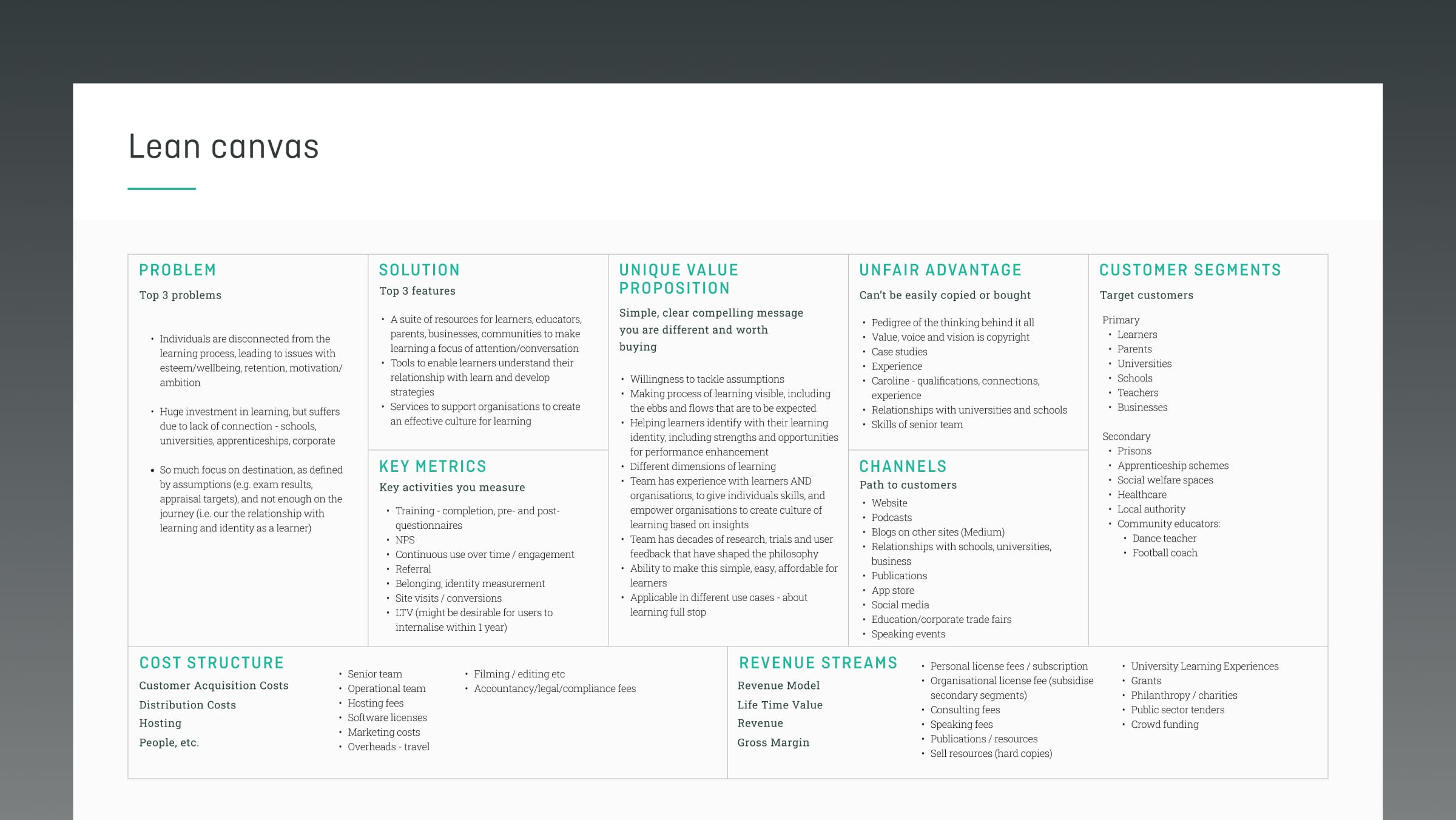
We guide your team through each segment of the Lean Canvas template and capture agreed decisions as we go. The canvas typically includes:

  • Problem: the customer pain points the product will solve
  • Customer segments: the primary users or buyers
  • Unique Value Proposition: why your solution stands out
  • Solution: the core features or service elements that address the problem
  • Channels: how you will reach and acquire customers
  • Customer relationships: how you will support and retain them
  • Revenue streams: how the product will generate income
  • Key resources: the assets and capabilities you will rely on
  • Key activities: the critical work that delivers the value
  • Key partnerships: the external relationships that enable delivery
  • Unfair advantage: something about your product that cannot be easily bought or copied
  • Cost structure: the main costs involved in operating the model

Rather than working through this list in a rigid order, we use prompts and exercises to spark conversation. For example, we might start with the problem and customer segments, then move into the UVP to make sure the two align. The aim is not to fill boxes for the sake of it, but to have meaningful discussions that surface the most important assumptions. Once captured, these assumptions can then be tested with evidence, research, or prototypes.

An agile approach to concept development

Lean Canvas is not a static deliverable. It evolves as the team learns more about customers, competitors, and constraints. We encourage clients to treat it as a living artefact that anchors the design process, ensuring that each new insight feeds back into the overall business model.

Because the canvas is concise, it makes iteration straightforward. It can be revisited quickly in a team session or updated after new research findings. This agility makes it a cost-effective tool that reduces risk, shortens decision cycles, and ensures the product remains grounded in both user needs and business goals. The Lean Canvas also creates a natural bridge between strategy and design. By the time the team moves into concept validation or rapid prototyping, there is already a shared framework that ties together the business case, the customer problem, and the intended solution.

Typical outcomes include

  • A completed Lean Canvas that captures a shared view of the proposition
  • Clear problem and customer definitions grounded in available evidence
  • A concise Unique Value Proposition that aligns product and market needs
  • A prioritised list of assumptions and risks with proposals for how to test them
  • Initial success measures and signals to track during discovery and early release
  • A short set of next steps that feed directly into research, prototyping, or delivery planning
  • A lightweight playback deck that communicates the concept to stakeholders
  • Increased alignment across product, design, engineering, and leadership teams

If you want to bring structure and clarity to an early idea, our facilitated Lean Canvas sessions provide a fast way to align your team and move confidently into validation and design.

FAQs

What is the purpose of a Lean Canvas workshop?

A Lean Canvas workshop helps teams capture the core elements of a product concept on a single page. It surfaces assumptions, defines customers and problems, and creates a clear framework that can guide design and business decisions.

When should Lean Canvas be used in a project?

It is most valuable in the early stages of ideation or strategy, when options are being explored and prioritised. However, it can also be revisited later to refine the business model as new evidence emerges or customer insights are gained.

How does Lean Canvas differ from a traditional business plan?

Unlike long business plans, Lean Canvas is deliberately concise and designed to evolve. It provides a fast, collaborative way to align stakeholders and test assumptions without committing time and resources to detailed documents that may quickly become outdated.

Book a virtual coffee

Speak directly with our founders Ed and Jon about how we can help you on your Innovation or Transformation project.

Contact
Ed & Jon

Contact details

Find us

Cheyenne House
West Street
Farnham, Surrey
GU9 7EQ

Cheyenne House
West Street
Farnham, Surrey
GU9 7EQ

Contact form

Looking for a long term partner to support your business?

By browsing our website you agree to our cookie policy. You can opt-out anytime from our cookies page